

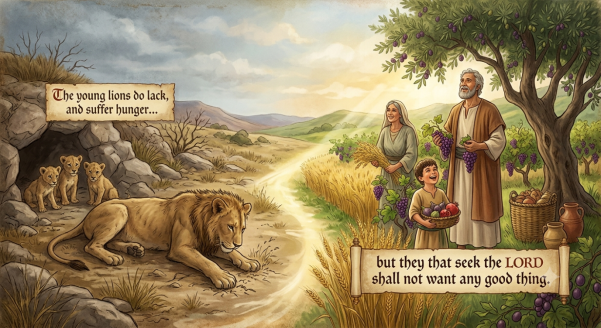
Psalm 34:10 declares a startling contrast: “The young lions do lack and suffer hunger: but they that seek the LORD shall not want any good thing.” David, having just fled Abimelech feigning madness, does not reach for a weak or timid creature to illustrate need.
He reaches for the young lion in its prime, the apex predator of the ancient Near East, an image everywhere else in Scripture reserved for kings, warriors, and Messiah himself. This is deliberate. If David wanted merely to say, “even strong things fail,” a lamb or sparrow would not do.
He needed the strongest conceivable provider to demonstrate that strength itself is not the ground of provision. The lion hunts by claw, muscle, and instinct honed by God, yet Scripture insists that this same creature, at the height of its power, can still know (ra’ev), hunger, and (chaser), lack.
The rhetorical logic is an argument from the greater to the lesser, inverted: if the mightiest natural provider, feared across the ancient world, can still fail, then provision was never fundamentally about might. It was always about the character of the one being trusted, not the raw power of the one providing.
The Strong ones who failed.
Howard Hughes commanded one of the largest fortunes on earth, yet died isolated, his estate consumed for years by litigation, leaving heirs and dependents in prolonged uncertainty rather than settled provision.
Mobutu Sese Seko ruled Zaire for over three decades, amassing a fortune estimated in the billions, yet died in exile in 1997, and the family he sought to secure through absolute power fell into disgrace and want almost overnight. In our own time, we see the same pattern.
A devoted parent works two jobs, sacrifices sleep, and saves meticulously, only to see a cancer diagnosis drain every resource. A farmer who has mastered the land, rising before dawn for decades, loses a year’s harvest to a flood that does not respect his expertise.
A successful entrepreneur, riding the crest of a booming market, wakes to a crash that vaporises assets overnight, leaving a family’s security in ruins. These are not failures of will. They are demonstrations that human capacity, however formidable, is hemmed in by forces beyond its control. The young lion did its best, and its best was not enough; hunger still came.
God Provides Better
This is precisely where the Psalm turns from observation to invitation. The text does not merely diagnose creaturely limitation; it names the alternative: those who seek (dorshei) the LORD. The promise is not that such people will never labour, nor that provision arrives without means; the same Psalm, elsewhere, assumes ordinary human responsibility.
Rather, the promise is that the source behind the means will not run dry, because it is not bound by the same finitude that eventually starves every lion. Real-life testimony demonstrates this providence in action. George Müller, caring for thousands of orphans in nineteenth-century Bristol, never made his needs known to anyone but God. On one well-known morning, with no food for breakfast, he prayed and thanked God for the provision not yet seen.
A baker, awakened in the night, had felt compelled to bake bread for the orphanage; a milkman’s cart broke down conveniently at the doorstep, forcing him to distribute milk before it spoiled. These were not windfalls of chance but synchronised, specific answers.
In the Sudanese civil war, believers fleeing into the bush testified that they prayed for food and found wild fruit in abundance where none had been reported, sustaining them until they reached safety. Countless Christians in underground churches have shared accounts of a stranger handing them exactly the sum needed for rent, at the very hour prayer was offered.
These stories do not deny the reality of suffering; they rather insist that amid the young lion’s failure, God’s resources materialize in ways that defy statistical explanation.
Trust God, not your might
Why, then, should trust rest in God’s providence rather than in strength, wealth, or preparation, all of which remain legitimate and even commanded means? Because providence, biblically understood, is not a mechanism but a Person.
Hughes and Mobutu failed not from want of trying but because their provision was ultimately self-referential, dependent on a system, a body, a fortune, all of which are contingent, finite, and mortal, however impressive they appear in the moment of their strength. God’s provision is grounded in His unchanging hesed, His covenant loyalty, which does not degrade with age.
To trust His providence is not passivity; it is to labour as stewards while resting as children, refusing to make one’s own strength, however formidable, the final guarantee of tomorrow. The young lion still hungers. The one who seeks the LORD does not lack. That is the wager Psalm 34:10 asks every believer to make, and modern history, in its own sobering and repeated way, keeps confirming why it remains, of all possible wagers, the wisest one a person can ever place.


