

By Pr Isaiah White
Jerusalem, circa A.D. 30, the room was tight with fear, a heavy bolt across the door, the only barricade against a city hunting Jesus’s followers. Earlier that week, while Thomas was absent, the crucified Jesus had appeared alive among the disciples. When Thomas returned, they greeted him with, “We have seen the Lord!”
Thomas did not celebrate. Grief has its own logic, and he had buried his hope the moment Jesus died. To accept the resurrection now felt emotionally impossible; a cruel trick that might break him again. So he set a condition: “Unless I see the nail marks in his hands and put my finger where the nails were, and put my hand into his side, I will not believe.” It was not curiosity; it was a wounded heart erecting a shield.
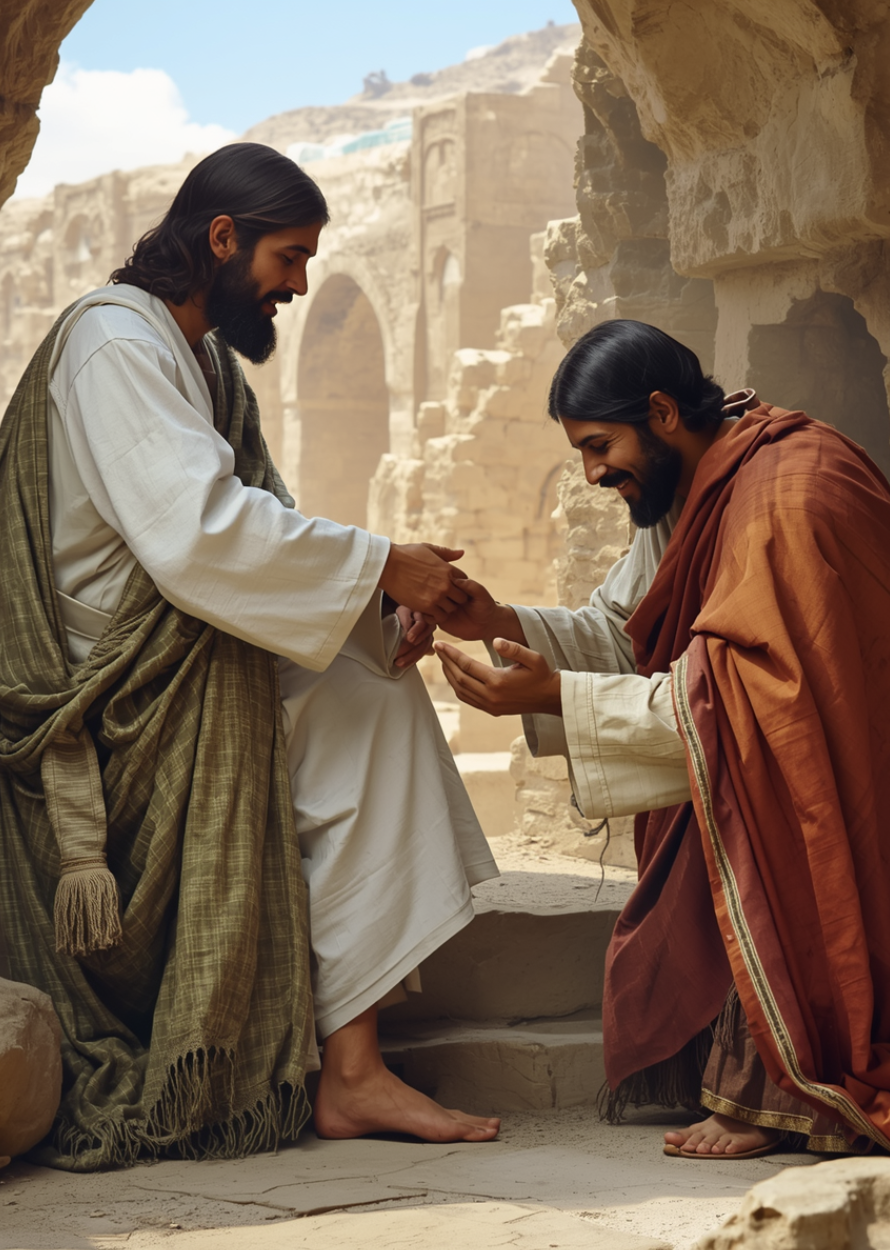
Eight days later, in the same locked room, Jesus appeared again, walking straight to Thomas and offering his hands: “Put your finger here; see my hands. Reach out your hand and put it into my side. Stop doubting and believe.” Thomas, suddenly small before the evidence he had demanded, whispered the highest Christology in the Gospels: “My Lord and my God!”
This encounter, recorded in John 20, has labeled a man forever as “Doubting Thomas.” But it also opens a conversation for both the faithful and the skeptical: What is doubt? Why does the Bible warn against it? And can an honest doubter find God?
What is doubt?
Doubt is uncertainty of mind; the gap between a claim and the evidence one feels is needed to accept it. The Greek word behind “stop doubting” in John 20:27 is ‘apistos’, meaning ‘unbelieving’ or ‘without faith’. It can range from the humble cry, “Lord, I believe; help my unbelief” (Mark 9:24), to a hardened refusal to trust.
Doubt is not the same as honest inquiry. A scientist testing a hypothesis is searching, not doubting in the biblical sense. Biblical doubt, especially toward God, describes a heart that pulls back and refuses to trust God’s faithfulness despite the evidence already given. Thomas had walked with Jesus for three years and watched Lazarus rise from the dead, yet in his pain he set that evidence aside and demanded fresh proof. The danger, Scripture says, is not the momentary question but the settled posture of unbelief that shrinks the soul.
The danger of doubting
For those who already profess faith, Scripture warns that doubt corrodes spiritual vitality. James writes bluntly that “the one who doubts is like a wave of the sea, blown and tossed by the wind” and “should not expect to receive anything from the Lord” (James 1:6–7).
Hebrews states the principle plainly: “Without faith it is impossible to please God, because anyone who comes to him must believe that he exists and that he rewards those who earnestly seek Him” (Hebrews 11:6). Faith is not a leap in the dark but trust in a God who has already spoken. When Israel doubted God’s promise at the edge of Canaan, a whole generation wandered the desert until it perished.
Paul draws an equally sharp line: “Whatever is not from faith is sin” (Romans 14:23). His point is pastoral: acting against one’s own conscience creates a divided heart that cannot act with the freedom God intends. A believer who persistently doubts God’s goodness finds love growing cold and prayer mechanical.
Even Peter, walking on water, became a cautionary figure. He stepped out in faith, but seeing the wind, grew afraid and began to sink. Jesus caught him, asking, “You of little faith, why did you doubt?” (Matthew 14:31). The instant his gaze shifted from Christ to the chaos, the impossible became impossible again.
Does this forbid honest questions? No. The Psalms are full of raw lament that sounds almost like doubt: “My God, my God, why have you forsaken me?” (Psalm 22:1). The difference is that the psalmist brings his questions to God rather than walking away. Honest struggle, placed before the Lord, can deepen faith. The danger is not the question itself but the quiet resignation that God might not be trustworthy, and the decision to stop seeking him.
Doubting God’s existence, power
Here Scripture’s tone shifts from pastoral warning to urgent appeal. “The fool says in his heart, ‘There is no God'” (Psalm 14:1). The Hebrew word for “fool,” nabal, describes not a lack of intelligence but a moral blindness; a refusal to live in the light of what is plain.
Romans 1:20 expands the argument: God’s “invisible qualities; His eternal power and divine nature; have been clearly seen, being understood from what has been made, so that people are without excuse.” The cosmos itself, in this view, is a permanent testimony: a universe finely tuned for life, a moral law written on human hearts, and an irrepressible longing for transcendence all leave humanity accountable.
To doubt God’s existence and power is therefore not a neutral position but, Paul says, a suppression of truth (Romans 1:18). Jesus put it starkly: “Whoever does not believe stands condemned already because they have not believed in the name of God’s one and only Son” (John 3:18). The Bible treats unbelief not as a harmless stance but as the great barrier to life itself.
Yet Scripture does not leave the doubter without a defence. In fact, the story of Thomas is one of the Bible’s most powerful answers to honest scepticism.
In defence to the doubters
God does not run from human doubt; he walks through locked doors. When Jesus appeared to Thomas, he did not scold him for wanting evidence; he met the demand exactly as stated. The resurrected body still bore its scars, as if kept precisely for doubters to examine.
This pattern runs throughout Scripture. Moses doubted his ability to confront Pharaoh, so God gave him miraculous signs. Gideon doubted God’s promise of victory, so he laid out fleeces, and God patiently answered twice. When John the Baptist, imprisoned and near despair, asked whether Jesus was truly “the one who is to come,” Jesus pointed to the evidence; the blind seeing, the lame walking, the dead raised (Matthew 11:4–5); then publicly honored John as the greatest of those born of women.
The God of the Bible invites investigation. “Come now, let us reason together,” says the Lord through Isaiah (Isaiah 1:18). The early Church did not seal the tomb and demand blind allegiance; it staked everything on a publicly verifiable event. Paul reminds the Corinthians that the resurrected Christ appeared to over five hundred people at once, most of whom were still living; in effect: go ask them, check the sources.
The Christian claim is not that faith occurs in an evidence vacuum, but that God has provided sufficient witness; in creation, Scripture, history, and changed lives; to bring a person to a place of decision. The defense to the doubter is an open hand, not a clenched fist. But the hand holds scars.
Jesus’s closing words to Thomas are both gentle and searching: “Because you have seen me, you have believed; blessed are those who have not seen and yet have believed.” This is not anti-evidence; it is pro-faith. It describes those who, examining the apostles’ testimony, trust the God who raised Jesus from the dead. Their trust, though it lacks Thomas’s physical sight, is no less rational; and carries a special blessing.
Importance of faith in life
Why does any of this matter beyond religious circles? Because every human being lives by faith in something. The scientist trusts the uniformity of natural law each time she runs an experiment; the driver trusts that cross traffic has stopped before accelerating through a green light. Relationships, economies, and democracies all run on trust that goes beyond absolute proof. Faith is not a religious eccentricity; it is a fundamental human faculty.
What the biblical narrative offers is a specific object for that faith; not abstract optimism, but a personal God who has entered history, borne suffering, and conquered death. Faith in this God reorders a life: it supplies meaning when existence feels random, forgiveness when guilt suffocates, and hope as death approaches. Hebrews calls faith “confidence in what we hope for and assurance about what we do not see” (Hebrews 11:1); not make-believe, but forward-leaning trust anchored to the character of a proven God.
Believing is not always easy. The same Thomas who demanded evidence would later, according to tradition, carry the gospel as far as India and die a martyr’s death. His doubt was a chapter, not the whole story. Believers across centuries have found that faith can coexist with tears, unanswered questions, and seasons of dryness; but its trajectory is toward life. Jesus said, “I have come that they may have life, and have it to the full” (John 10:10). Faith opens the door to that fullness.
For the skeptic weary of doubt’s empty rooms, the invitation remains: “Seek, and you will find; knock, and the door will be opened to you” (Matthew 7:7). God does not reward pretense; he rewards the honest search. The philosopher Simone Weil once observed that Christianity’s greatness lies not in offering an escape from suffering, but in giving suffering a redemptive purpose. The wounds of Christ, which Thomas touched, are the ultimate evidence that God does not distance himself from human pain but redeems it.
We are called to believe, not because doubt is beyond understanding, but because the One we are invited to trust is trustworthy. He met Thomas in his ultimatum. He meets modern doubters still; in the pages of the Gospels, in a world that whispers of design, and in the quiet presence of a Spirit who disturbs the comfortable and comforts the disturbed.
The door of that room in Jerusalem may be locked, but the invitation inside remains open. The scars are still extended. “Stop doubting and believe.” For the honest heart; whether in a pew on Sunday or on a park bench arguing against God; those words are not a threat. They are a lifeline.


