By Beatrice Nakibuuka
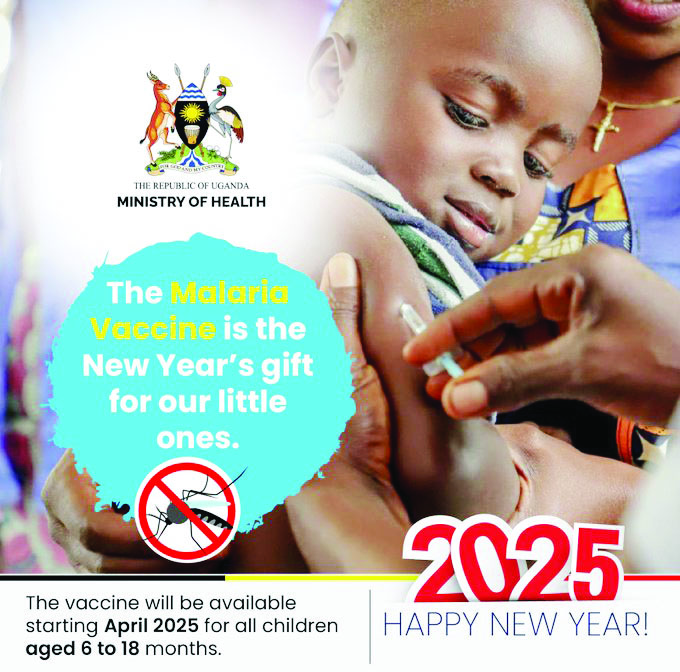
In April 2025, Uganda embarked on a groundbreaking health initiative by incorporating a four-dose malaria vaccine into its routine immunisation schedule. Aimed at protecting infants aged 6 to 18 months, the campaign represents the world’s largest malaria vaccine rollout to date, targeting more than 105 districts with high or moderate transmission rates.
This ambitious undertaking signals a critical advancement in child health. With a reported efficacy of up to 77 per cent, no cost to families, and robust government support, the vaccine provides a vital new layer of protection for Uganda’s most vulnerable population, its children.
Administered in four doses at 6, 7, 8, and 18 months, the R21/Matrix-M malaria vaccine complements existing malaria control measures. But Dr Jimmy Opigo, head of Uganda’s National Malaria Control Programme, cautions: “To fully succeed, vaccination must work hand-in-hand with proven interventions like bed net use, indoor spraying, and prompt treatment. What Uganda is doing now could pioneer a path toward a malaria-free future.”
Why malaria still matters
Malaria remains one of Uganda’s most pressing public health challenges. It is the leading cause of illness and death, particularly among children under five. According to the World Health Organization (WHO), 95 per cent of the country experiences malaria transmission. Uganda has one of the highest malaria incidence rates globally, with 478 cases per 1,000 people annually.
Despite decades of interventions—mosquito net distribution, indoor residual spraying, and improved treatment—malaria continues to claim thousands of lives. Government figures show that the disease accounts for 40 per cent of outpatient visits, 25 per cent of hospital admissions, and 14 per cent of hospital deaths. Each year, between 70,000 and 100,000 Ugandans die from malaria—far surpassing fatalities from HIV/AIDS.
The burden is not evenly spread. Sub-regions such as Karamoja, Acholi, and Bukedea continue to report surges in malaria cases, especially during peak transmission seasons, with over 300,000 cases weekly at the height of outbreaks.
Persistent obstacles
While interventions have made strides, significant challenges remain. In rural communities, some residents misuse mosquito nets for farming or livestock purposes. Insecticides meant for home spraying are often diverted for use on crops, reducing their effectiveness and contributing to mosquito resistance.
Self-medication is another major issue. Many Ugandans purchase antimalarial drugs over the counter without proper diagnosis, risking incorrect dosing and treatment failure. “Improper treatment leads to drug resistance and recurring infections,” warns Ignatius Asasira, a public health advocate at Makerere University.
“We always advise seeking care from qualified health workers,” he adds.
New threat emerges
Adding to these challenges is the emergence of a new mosquito species, Anopheles stephensi, identified in 2023 by the Kenya Medical Research Institute (KEMRI). Unlike native species, this fast-spreading mosquito thrives in urban environments, threatening to reverse decades of progress. It transmits the two malaria parasites that pose the greatest risk of severe illness and death: Plasmodium falciparum and Plasmodium vivax.
Across Africa, malaria is resurging. In 2021, Nigeria, the Democratic Republic of Congo (DRC), Tanzania, and Niger accounted for half of global malaria deaths. Experts attribute this resurgence to several factors, including disruptions caused by the Covid-19 pandemic, growing insecticide resistance, and behavioural changes in mosquito activity.
Technological efforts such as genetically modified mosquitoes offer promise, but their impact has been limited by evolving resistance among both mosquitoes and Plasmodium parasites. To combat these emerging threats, stronger national regulatory frameworks and enhanced international cooperation are essential.
Vaccine rollout across Africa
Uganda is not alone in deploying the malaria vaccine. As of April 2025, 20 African countries—including Ghana, Kenya, Malawi, Cameroon, Sierra Leone, Benin, Liberia, South Sudan, Nigeria, and the DRC—had introduced malaria vaccines into their national immunisation programmes. Burundi is also in the process of joining them.
Most countries are using the RTS,S vaccine, though a few have also introduced the R21 variant. In Uganda, both public and private health facilities are offering the vaccine to children aged 6 to 18 months. Children who are unwell must first be treated before receiving the vaccine.
The programme officially launched in Apac District on April 2, 2025—an area recognised for having among the highest mosquito exposure rates globally. The Ministry of Health aims to immunise 1.1 million children in the first year, distributing 2.3 million doses by mid-2025.
Initial response has been positive. Many caregivers have expressed hope that the vaccine will reduce hospital visits, treatment expenses, and time lost from work or school.
Complementing existing measures
Dr Opigo emphasises that the vaccine is not a standalone solution.
“It complements other malaria control strategies like sleeping under treated nets, indoor spraying, and seasonal chemoprevention,” he explains.
The economic burden of malaria on households is considerable. A single episode costs an estimated USD 9 (UGX 34,000), a significant expense for low-income families. Complicated cases come with added costs such as transport, meals, and lost income. For the nation as a whole, the disease undermines education, productivity, and development.
In 2019 alone, Uganda spent USD 32 million on malaria prevention and treatment. Families bore much of this cost, often straining already tight budgets. The vaccine, however, is being provided free of charge in public health facilities. Parents are urged not to pay any fees for it.
The initial 3.5 million doses costing nearly USD 9 million, were procured with funding from Gavi, the Vaccine Alliance, in partnership with the Ugandan government.
How the vaccine works
The RTS,S vaccine is administered via injection in the right thigh. It prompts the immune system to produce antibodies that prevent the Plasmodium falciparum parasite from infecting liver cells, thereby stopping the disease from developing into a full-blown illness.
To be fully effective, all four doses must be received. Protection typically lasts between three and four years. Dr Opigo says: “Breakthrough cases may still occur so the use of bed nets and early treatment remains crucial.”
Other control strategies
Vaccination is part of a broader strategy. Uganda also employs seasonal malaria chemoprevention (SMC) in high-risk regions like Karamoja. Larviciding—targeting mosquito breeding sites—and intermittent preventive treatment during pregnancy (IPTp) are other critical measures in the national strategy.
Community engagement is playing a pivotal role. Village Health Teams (VHTs) are educating the public about the vaccine, promoting proper net use, and dispelling common myths.
Health Minister Dr Jane Ruth Aceng describes the vaccine as a “game-changer”. “It can save thousands of lives, reduce hospital congestion, and give children a better chance to thrive,” she says.
However, the success of this campaign depends heavily on behaviour change. Households must consistently use and maintain mosquito nets and seek treatment promptly when symptoms arise. In some districts, bylaws are being introduced to encourage proper net usage.
Looking ahead
Uganda plans to scale up the programme to reach all 107 districts, aiming to administer 4.1 million doses by 2026. The sustainability of this initiative will depend on continued support from Gavi, UNICEF, WHO, and the Ugandan government. Key investments are already underway in logistics, cold-chain infrastructure, community engagement, and health worker training.
Meanwhile, global research into next-generation vaccines continues. Advances in technology could eventually yield formulations offering even stronger protection and longer-lasting immunity.
Uganda has set itself an ambitious target: to eliminate malaria by 2030. The introduction of the vaccine is a crucial step on that path. With sustained political will, sufficient funding, community participation, and scientific innovation, this goal is within reach.
As Dr Opigo concludes: “The launch of the malaria vaccine in Uganda is a moment of hope and progress. It represents a major public health milestone in the fight against one of our oldest and deadliest diseases. While it won’t end malaria overnight, it provides a powerful new shield for our children—the ones who need it most.”